

OUR HISTORY
Charlton Benefice brings together three Church of England congregations in Charlton: St Luke’s, St Thomas’, and St Richard’s. Each church has its own character and history, but together we form one worshipping community serving the neighbourhood.
Christian worship has taken place in Charlton for many centuries. As the area grew and changed, new church buildings were established so that local people could gather for worship, prayer, and community life.
Today the Benefice reflects the diversity of Charlton itself. Our three churches offer different styles of worship and community life, but share the same commitment to following Jesus, serving our neighbourhood, and welcoming people of all ages and backgrounds.
Our churches have a long history of supporting LGBTQ+ inclusion and that continues today.
Our Buildings:
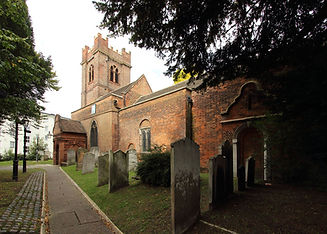
St Luke’s Church
St Luke’s is the historic parish church of Charlton and has been a place of Christian worship for almost a thousand years. Records suggest that a church stood on this site as early as the 11th century, making it the oldest place of worship in the area.
The present building was largely rebuilt in the 1630s, funded by Sir Adam Newton, who lived at nearby Charlton House. Much of the red-brick church that stands today dates from this period.
St Luke’s has long been connected with prominent local families who supported and shaped the life of the parish. The Maryon‑Wilson family, whose estate included Charlton House and the surrounding land, were patrons of the living for many years and played an important role in the church’s history.
The church is also the burial place of Spencer Perceval, the only British Prime Minister ever to be assassinated. His grave remains an important historical point of interest.
Today St Luke’s, a Grade II* listed building, continues its long tradition as a place of worship, prayer, and community gathering at the heart of Charlton Village.

St Thomas' Church
St Thomas’ Church was built between 1848 and 1850 as Charlton’s population expanded during the Victorian period. It was designed by Joseph Gwilt and consecrated in 1850.
The church was established to serve the growing community beyond the historic village and became a new centre for worship and parish life.
Among those buried in the churchyard is Ann Flinders, the wife of the famous explorer Matthew Flinders, who led the first circumnavigation of Australia and helped establish the name of the continent. Her grave is a quiet reminder of the area’s connections to wider global history.
Today St Thomas’ continues to serve the local community as part of Charlton Benefice, hosting worship, community events, and gatherings.

St Richard's Church Centre
St Richard’s began in a very different way from the older parish churches. The first building on the site was a tin mission hut, established to serve the growing community in New Charlton.
In 1958 the current church building was constructed to replace the earlier structure. From the beginning, the church focused on serving the surrounding neighbourhood and creating space for community life.
Today St Richard’s continues that spirit. It is a place where people gather for worship, conversation, creativity, and community, and where new expressions of church life are explored.